



Avatar Nexus
Project Overview
Modern supply chain planning relies on multiple scenarios to evaluate different strategies, but comparing outcomes and identifying issues across them quickly becomes complex.
Designing agentic AI for supply chain planning — enabling Elixum planners to understand, compare, and resolve complex scenarios through conversational intelligence and autonomous agent groups.
Product: Avatar AI Agents & Agent Groups
Domain: AI-powered Supply Chain Planning
Platform: Enterprise Web Application
Role: UX Designer & UX Strategist
Project Type: Conceptual / Product Enhancement

01 — Background & Problem
Elixum gave planners power.
Avatar Nexus gives them intelligence.
🏗️
Built on Elixum
Elixum introduced modular supply chain planning — strategic network planning, demand management, S&OE, and production scheduling — on a composable, infrastructure-agnostic platform. Avatar Nexus is the AI intelligence layer on top of this foundation, extending the same personas into an agentic planning experience.
Modern supply chain planning relies heavily on scenario-based planning. Elixum planners work with multiple scenarios simultaneously — Scenario A, B, C — evaluating strategies for demand, supply, capacity, and risk. Powerful in theory. Overwhelming in practice.
Avatar AI Agents were introduced as an intelligent layer on top — helping those same Elixum users analyze, reason, and act across scenarios through conversational AI and autonomous agents.
The challenge wasn't adding AI. It was designing for agentic UX — where the system doesn't just respond but proactively monitors, reasons, and executes on behalf of the user without sacrificing their sense of control.
Every interaction had to balance autonomy with trust, especially in high-stakes enterprise supply chain decisions where a wrong recommendation costs millions.
"How might we enable Elixum planners to understand, compare, and resolve scenario-based planning issues using AI — while maintaining control, trust, and transparency?"
User Pain Points (surfaced from Elixum research)
🔄
Scenario Overload
Managing 5+ planning scenarios simultaneously caused cognitive fatigue — users toggled between tabs, losing context across every switch.
🔍
Root Cause Blindness
Identifying why issues appeared across scenarios required manual cross-referencing of KPI tables — error-prone and hours-consuming.
⚙️
Repetitive Manual Analysis
Planners ran identical analytical sequences daily — ideal for automation — yet no intelligent layer existed to offload this cognitive labour.
🤖
AI Trust Deficit
Early AI recommendations in Elixum's beta had no explanation layer. Users ignored them entirely, defaulting to manual decisions.
02 — Design Process
Design Thinking Framework
An iterative, non-linear process used to understand users, challenge assumptions, redefine problems, and create innovative solutions.
Core Agentic UX Principles Applied
1
Human-in-the-Loop
Every autonomous agent action that affects planning data requires explicit user approval. The system acts, but humans decide.
2
Explainable Decisions
Every AI insight surfaces its data source, assumptions, and confidence level — turning the black box into a glass box.
3
Progressive Trust Building
Agents start with recommendations, earn trust through accuracy, then unlock automation capabilities incrementally.
Understand
Explore
Materialize
Empathize
Research users' needs
1
Define
State users' problems
2
Ideate
Challenge assumptions
3
Prototype
Create solutions
4
Test
Try solutions out
5
Implement
Introduce to markets
6
03 — User Personas
From Elixum Planners → Avatar Nexus Power Users
These four personas were first established during Elixum's foundational UX research — 1-on-1 interviews with supply chain account managers. Avatar Nexus was designed to serve these same users, now with agentic AI capabilities layered on top of their existing Elixum workflows.
🔗
Persona continuity: These are not new users. Avatar Nexus extends the Elixum user base — the same people who struggled with scenario overload in Elixum now gain agentic AI capabilities to solve those exact problems.

Forecasting
ML Models
Daily User
Elixum Context
Uses Elixum's demand management module daily. Runs statistical + ML forecasting workflows. Manually tracks 3–5 scenarios per product family.
↑ Avatar Nexus Upgrade
Avatar Nexus gives them a Demand Agent that automatically detects demand spikes, surfaces root causes, and answers natural-language queries like "Why did Scenario A spike last week?"
Before
Spends 40% of day on repetitive analysis
After
Delegates analysis to Demand Agent

Risk Monitoring
KPI Tracking
Multi-Scenario
Elixum Context
Monitors inventory buffers and supply constraints across Elixum's network planning module. Manages KPI dashboards across multiple scenarios.
↑ Avatar Nexus Upgrade
Avatar Nexus provides a Supply Agent that monitors inventory risk across all scenarios in parallel and sends proactive alerts before SLAs are breached.
Before
Manual cross-referencing between scenario views
After
Supply Agent proactively flags anomalies

Supplier Coordination
S&OE
Action-Oriented
Elixum Context
Coordinates supplier lead times and capacity commitments using Elixum's S&OE module. Needs to align procurement actions with planning scenario outcomes.
↑ Avatar Nexus Upgrade
Avatar Nexus lets them query cross-scenario supplier impacts in natural language and receive consolidated action recommendations from multi-agent analysis.
Before
No visibility into how scenarios affect suppliers
After
Cross-scenario supplier impact queries

Executive Review
Risk Approval
Strategic
Elixum Context
Reviews all scenario outcomes at a strategic level. Approves corrective actions. Relies on Elixum dashboards for executive planning reviews.
↑ Avatar Nexus Upgrade
Avatar Nexus gives them the Orchestrator agent — a meta-agent that correlates signals across Demand + Supply agents and delivers boardroom-ready consolidated insights and action plans.
Before
Manually synthesises insights from multiple sources
After
Orchestrator delivers consolidated executive insights
Goals & Target Success Metrics
Business Goals
Increase adoption of AI-driven planning features
Reduce manual effort in scenario analysis
Enable scalable automation through agent groups
User Goals
Quickly understand issues across planning scenarios
Delegate repetitive analysis to AI agents
Gain confidence in AI-driven recommendations
30%
Less scenario analysis time
Baseline from Elixum user research
40%
Reduction in Manual Checks
Through intelligent agent automation
↑
Increased AI agent usage
Session frequency & depth tracking
★★★★☆
Trust & satisfaction
Post-launch survey target
04 — The Solution
Avatar Nexus — Two layers of intelligence
Avatar Nexus delivers AI-driven supply chain intelligence through two complementary capabilities — each designed to meet users where they are in their planning workflow.
💬
Basic Capability
Conversational Scenario Analysis
Users create chat sessions linked to specific planning scenarios. Through natural language, they can ask questions, surface anomalies, and explore root causes without leaving their planning context.
"Why is Scenario A showing higher inventory risk?"
"What changed in Scenario B that increased utilization?"
"Compare demand patterns across all active scenarios"
🤖
Advanced Capability
Agent Groups — Multi-Agent Orchestration
Agent Groups combine multiple specialized agents into a coordinated system. Rather than analyzing issues in isolation, they share context and collaborate to identify complex cross-scenario patterns.
→
Demand Agent detects unexpected demand spikes
→
Supply Agent flags supplier delay patterns
→
Orchestrator correlates signals cross-scenario
→
System delivers consolidated root-cause + action plan
User Flow
The user flow maps how Elixum planners move from their existing scenario workspace into Avatar Nexus — through conversational analysis, to agent delegation, to approved action execution. Explicit approval gates appear at every step that modifies planning data.
05 — High-Fidelity Designs
Basic Capabilities — Conversational Scenario Analysis
05-1 — Out of The box
Advanced Ideas
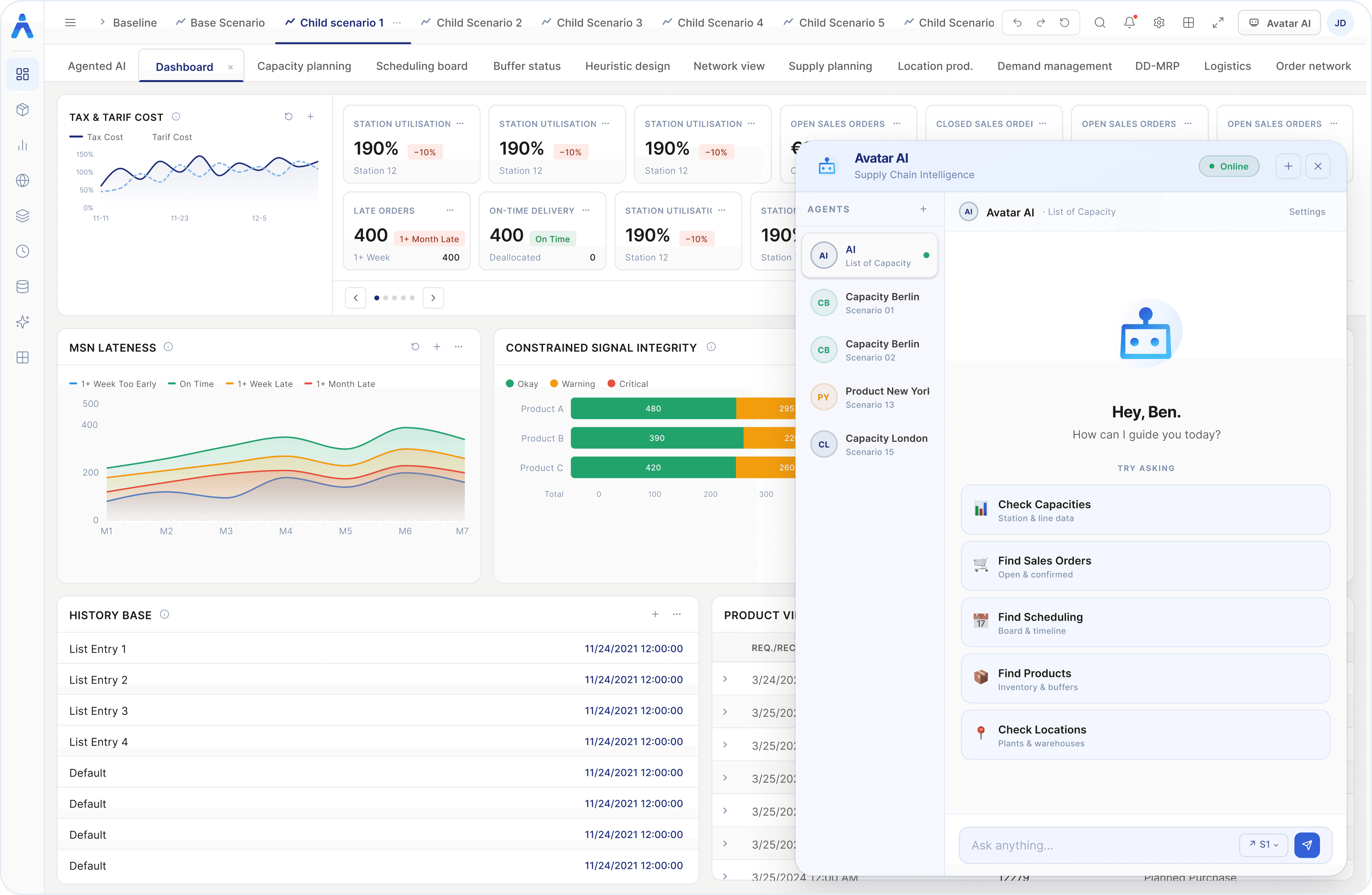
Five screens map the complete journey from landing in the Avatar Nexus home view through initiating a chat, receiving AI analysis, selecting scenarios for comparison, and continuing the conversation with refined queries.
Screen 1 of 5 — Conversational Scenario Analysis Home
1. Home — Avatar Nexus landing view. Scenario cards surface quick KPIs and alert counts. Users can initiate a chat session directly from a scenario card.
Screen 2 of 5 — Chatting with the Avatar Agent
2. Chat initiated — Conversational interface opens in context of the selected scenario. Suggested prompts help novice users get started quickly.
Screen 3 of 5 — AI Analysis Results
3. AI Analysis results — Agent surfaces root-cause insights with supporting data, confidence indicators, and actionable next steps. Every claim is traceable.
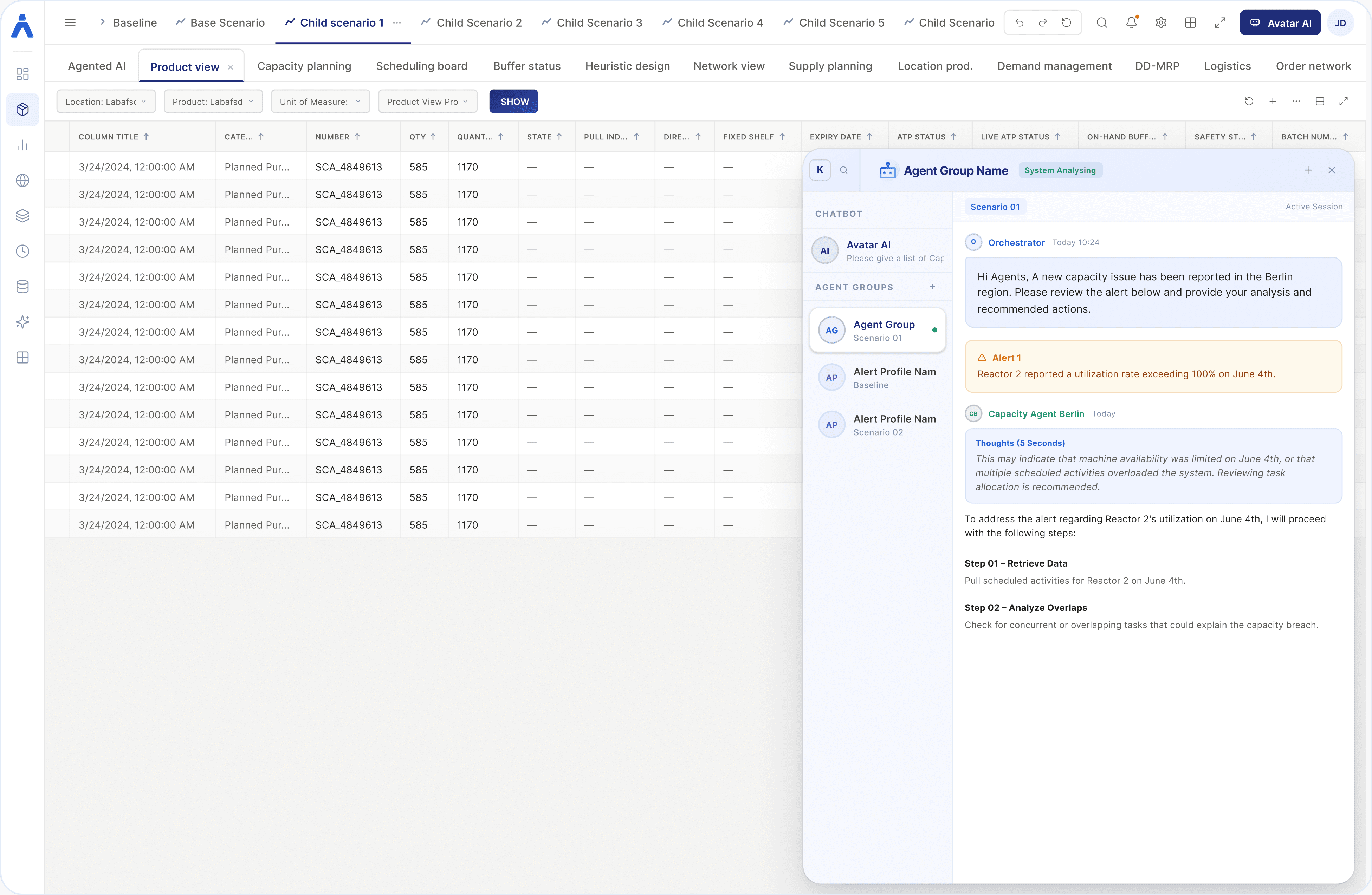
Screen 1 of 4 — Agent Groups Home
1. Agent Groups Home — Overview of active agent groups, their status, last run, and aggregated findings. Orchestrator agent is visible in-chat context.
Screen 2 of 4 — Agent Creation Flow
2. Agent Creation — Guided wizard for creating a new agent with defined scope, data access, trigger conditions, and escalation rules.
Screen 3 of 4 — Multi-Agent Orchestration
3. Multi-Agent Handling — Live view of multiple agents running in parallel, with progress indicators, interim findings, and correlation arrows between agents.
Screen 4 of 4 — Overview & Task Summary
4. Overview + Tasks Summary — Consolidated results from the agent group run, with actionable tasks, approval requests, and scenario recommendation cards.
Additional — Calendar & Filter Panel
Screen 1 — Summaries AI Orchestrator
Screen 2 — Conflict Resolution
Screen 3 — Execution
Screen 4 — Trust Layer
Screen 5 — Draft PR
5. Calendar Filter — Time-period selection for agent analysis scope. Supports rolling windows, fiscal periods, and custom date ranges.
05b — Advanced Capabilities
Agent Groups — Multi-Agent Orchestration
Four screens cover the Agent Groups experience: from the overview dashboard through agent creation, multi-agent coordination, and full-screen filtering — giving power users granular control over automated planning workflows.
06 — Responsible AI Design
Trust, Transparency & Control
In enterprise AI, trust is not a feature — it's a prerequisite. Every design decision in Avatar Nexus was filtered through three questions: Does the user understand what the agent did? Can they verify it? Can they override it?
🔍
Explainability by Default
Every insight includes its data sources, the assumptions made, and the confidence level. Users never face a bare conclusion.
📋
Assumption Disclosure
Agents surface their reasoning assumptions before acting — especially for automation scenarios. Users can challenge or adjust.
✅
Approval Gates
Any action that modifies planning data — adjusting parameters, triggering re-plans — requires explicit user approval. No silent mutations.
📖
Auditable Agent Logic
Agent rules can be reviewed, edited, and rolled back. The system is designed to be interrogatable — not just usable.
Accessibility & Ethics
✓
Clear, non-technical language
All AI explanations are written at plain language level — no jargon, no ambiguity.
✓
Avoidance of black-box decisions
No recommendation is surfaced without an accessible explanation of how it was derived.
✓
Human-in-the-loop automation
Automation is opt-in, scoped, and always reversible. Users set boundaries; agents respect them.
✓
Responsible AI principles
Fairness, accountability, and transparency baked into every agent design and capability scope.
07 — Design Impact
Great design removes friction. These numbers prove it.
Design impact was measured across three dimensions: speed, accuracy, and engagement — each directly tied to supply chain planning outcomes.
30%
Reduction in Analysis Time
Streamlined processes that reduce time spent on initial data preparation and scenario configuration.
"Avatar Nexus didn't just add AI to supply chain planning — it redefined how planners relate to their data. From passive consumers to active directors of intelligent systems."
40%
Reduction in Manual Checks
AI-augmented planning reduced manual checks by 40%, enabling faster and more accurate supply chain decisions.
↑↑
Template Adoption Rate
Higher engagement with AI-assisted templates, resulting in more consistent and efficient workflows.

start
Chat with
Avatar
AI analysis
scenarios
Chat Agent
e.g List Available Capacities
Orchestrator
e.g Remove Station Utilization Error
Scenario Creation
Agent Delegation /
goals
Changes in
Scenario
User
Action
Scenario Comparison
e.g Keep or discard

JD
Baseline
Base Scenario
Child scenario 1
···
Child Scenario 2
Child Scenario 3
Child Scenario 4
Child Scenario 5
Child Scenario 6
Avatar AI
JD
Agented AI
Dashboard
×
Capacity planning
Scheduling board
Buffer status
Heuristic design
Network view
Supply planning
Location prod.
Demand management
DD-MRP
Logistics
Order network
Scenario comp.
SC Network
Widget types
Add view
Tax & Tarif Cost
Tax Cost
Tarif Cost
11-11
11-23
12-5
0%
50%
100%
150%
Station Utilisation
190%
−10%
Station 12
Station Utilisation
190%
−10%
Station 12
Station Utilisation
190%
−10%
Station 12
Open Sales Orders
€698K
stable
Closed Sales
Closed Sales Orders
€698K
stable
Closed Sales
Open Sales Orders
€698K
−2%
Closed Sales
Open Sales Orders
€698K
stable
Closed Sales
Late Orders
400
1+ Month Late
1+ Week
400
On-Time Delivery
400
On Time
Deallocated
0
Station Utilisation
190%
−10%
Station 12
Station Utilisation
190%
−10%
Station 13
Supply Reliability
€698K
41% at risk
Open Sales
↗ Profile
MSN Lateness
1+ Week Too Early
On Time
1+ Week Late
1+ Month Late
M1
M2
M3
M4
M5
M6
M7
0
200
400
500
Constrained Signal Integrity
Okay
Warning
Critical
Product A
480
295
195
Product B
390
220
145
Product C
420
260
170
Total
0
100
200
300
400
500
Constrained Buffer Status
Blue
Green
Yellow
Red
Dark Red
Product A
12
45
18
Product B
38
22
10
Product C
15
52
14
History Base
List Entry 1
11/24/2021 12:00:00
List Entry 2
11/24/2021 12:00:00
List Entry 3
11/24/2021 12:00:00
List Entry 4
11/24/2021 12:00:00
Default
11/24/2021 12:00:00
Default
11/24/2021 12:00:00
Default
11/24/2021 12:00:00
Default
11/24/2021 12:00:00
Product View
REQ./REC. DATE
NUMBER
CATEGORY
3/24/2024 12:00 AM
12279
Planned Purchase
3/25/2024 12:00 AM
12279
Planned Purchase
3/25/2024 12:00 AM
12279
Planned Purchase
3/25/2024 12:00 AM
12279
Planned Purchase
3/25/2024 12:00 AM
12279
Planned Purchase
3/25/2024 12:00 AM
12279
Planned Purchase
3/25/2024 12:00 AM
12279
Planned Purchase
3/25/2024 12:00 AM
12279
Planned Purchase
Avatar AI
Supply Chain Intelligence
Online
Agents
AI
AI
List of Capacity
CB
Capacity Berlin
Scenario 01
CB
Capacity Berlin
Scenario 02
PY
Product New York
Scenario 13
CL
Capacity London
Scenario 15
AI
Avatar AI
· List of Capacity
Settings
Hey, Ben.
How can I guide you today?
Try asking
📊
Check Capacities
Station & line data
🛒
Find Sales Orders
Open & confirmed
📅
Find Scheduling
Board & timeline
📦
Find Products
Inventory & buffers
📍
Check Locations
Plants & warehouses
Ask anything…
↗ S1


© 2026. All rights reserved.
Muhammad Inzimam Saghir